The Transition of Ophthalmology from Binary Diagnosis to a Spectral Understanding of Disease
Concept Chapter – Dermophthalmology Foundation
Abstract
Modern Ophthalmology still largely operates within a binary disease model: a patient either has or does not have a condition. However, scientific evidence accumulated over recent decades demonstrates that many ocular conditions—such as blepharitis, Meibomian Gland Dysfunction (MGD), dry eye disease, and chalazion—are not isolated entities but represent different stages within the same pathological spectrum.This Concept Chapter introduces the Pathological Spectrum in Ophthalmology, highlighting the critical role of the eyelid microenvironment (ophthalmoderma) as a determinant of disease progression. Through historical, biological, and interdisciplinary analysis—including parallels with Dentistry, Dermatology, Neurology, and ancient Greek medical thought—it is argued that Ophthalmology is currently entering a new phase of scientific maturation.
Dermophthalmology is proposed as the integrative scientific framework that unifies skin and ocular surface into a single functional system, enabling a transition from fragmented symptom-based management to systemic prevention, visual stability, and improved quality of life.
Executive Summary
- Classical ophthalmic thinking treats diseases as isolated nosological entities.
- Contemporary evidence indicates that many ocular conditions exist along a continuous pathological spectrum (continuum).
- Chalazion, blepharitis, MGD, and dry eye disease are not independent conditions but stages of temporal and functional progression.
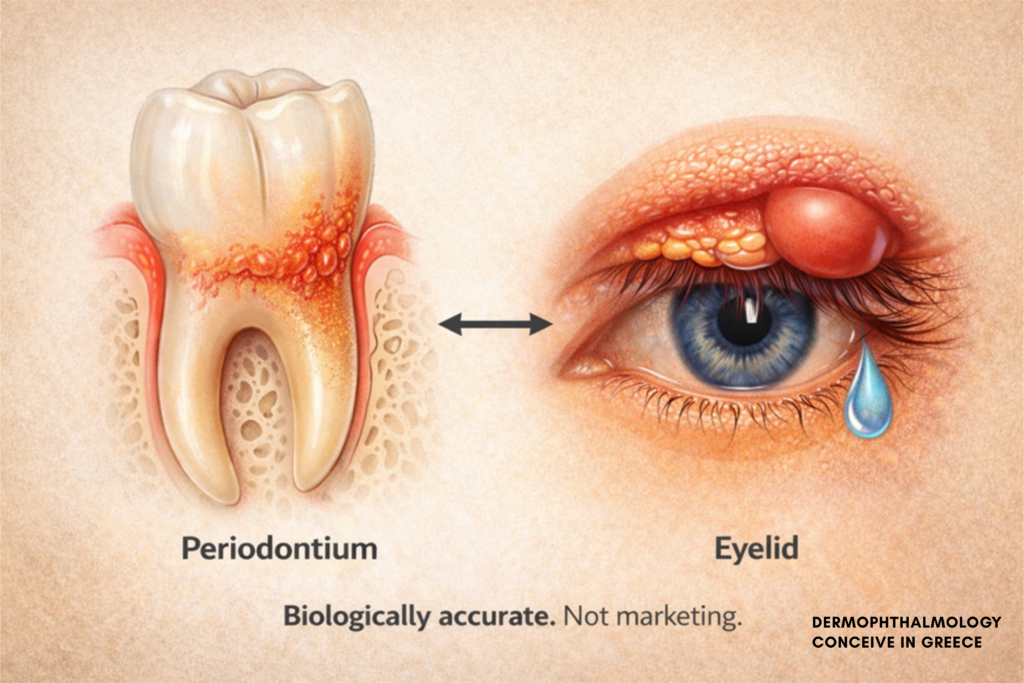
- Disease does not “reside” in the organ itself, but in the surrounding microenvironment.
- Just as Dentistry matured through recognition of the periodontium, Ophthalmology is now maturing through recognition of the eyelid.
- Dermophthalmology introduces a unified model for prevention, therapy, and public health.
- A shift in medical model requires a parallel shift in language, definitions, and clinical practice.
- This document serves as a scientific foundation for transition and a framework for future guidelines.
Significance of the Concept Chapter
Why this reframes Ophthalmology, clinical practice, and public health
This Concept Chapter marks a paradigm-level shift in how ophthalmic disease is understood, described, and prevented. It does not introduce a new pathology, nor does it propose novel pharmacological or surgical interventions. Instead, it redefines the conceptual framework within which ophthalmic disease is interpreted.
- Significance for Ophthalmic Science
Modern Ophthalmology remains largely structured around a nosological model: diseases are classified as discrete, isolated entities with clear diagnostic boundaries. While effective for acute pathology, this model fails to adequately explain the chronic, subclinical, and progressive dysfunctions that dominate contemporary eye care.By introducing the concept of the Pathological Spectrum in Ophthalmology, this Chapter reframes conditions such as blepharitis, meibomian gland dysfunction (MGD), dry eye disease, and chalazion as temporal and functional stages of a shared disease continuum, rather than unrelated diagnoses.
This shift:
- Moves Ophthalmology from static classification to dynamic disease modeling
- Incorporates time, progression, and neglect as core pathogenic variables
- Aligns ophthalmic thinking with spectrum-based models already adopted in other fields (e.g. Periodontology, Endocrinology, Neurology)
- Significance for Clinical Practice
Clinically, the spectrum model explains why symptom-based treatment alone often fails:
- why recurrences are common,
- why pharmacological escalation does not stabilize outcomes,
- and why patient frustration and non-compliance persist.
By identifying the eyelid microenvironment (ophthalmoderma) as a determinant of disease evolution, this framework redirects clinical focus:
- from symptom suppression → to substrate management
- from episodic intervention → to continuous prevention
- from isolated organ treatment → to functional system care
This does not replace existing treatments.It repositions them, clarifying when and why they work—or fail.
- Significance for Preventive Medicine & Public Health
The spectrum framework has direct implications for public health:
- It redefines hygiene from an optional recommendation to a foundational therapeutic principle
- It supports earlier intervention, before irreversible pathology emerges
- It reduces reliance on repeated medications and procedures
- It promotes patient education, self-care, and long-term stability
Just as the recognition of the periodontium transformed dental public health, the recognition of the eyelid as a functional regulator of ocular health represents a comparable step forward for Ophthalmology.
- Significance for Medical Language and Education
Current medical terminology is:
- binary (disease / no disease)
- static
- poorly suited to describe progression, risk, and subclinical states
This Chapter highlights the need for new conceptual language capable of describing:
- early dysfunction
- transitional stages
- environmental pathology
- prevention-oriented states
Such linguistic evolution is not cosmetic—it is structural.When the model changes, the language must follow.
- Why This Chapter Matters Now
The burden of chronic ocular discomfort, dry eye disease, and eyelid-related pathology is increasing globally, driven by:
- digital lifestyles
- aging populations
- environmental stressors
- cosmetic and dermatologic exposures
Yet the conceptual framework guiding care has not evolved at the same pace.This Concept Chapter arrives at a critical moment, offering:
- a unifying scientific narrative
- a bridge between Ophthalmology, Dermatology, and Preventive Medicine
- a foundation for future research, guidelines, and education
Defining Statement
This Concept Chapter does not add a new disease to Ophthalmology.It changes how disease itself is understood.
In doing so, it establishes Dermophthalmology not as a subspecialty trend, but as a necessary maturation of the field, aligned with modern biology, systems thinking, and public health priorities.
Position Statement
This Concept Chapter introduces a framework shift and does not propose or replace clinical guidelines. Its purpose is to redefine disease understanding, medical language, and prevention models in Ophthalmology through a spectral and systemic approach.
- Introduction – The Limits of the Binary Model
Twentieth-century medicine was built upon a powerful yet restrictive paradigm: diagnosis, treatment, cure. Disease was defined as an event rather than a process. In Ophthalmology, this translated into fragmented symptom management—eye drops, pharmacological regimens, and procedures—often without systematic understanding of the underlying substrate.The modern patient, however, rarely presents with acute, isolated pathology. Instead, chronic, subclinical, and progressively evolving dysfunction predominates.
- The Concept of the Pathological Spectrum
The spectral approach describes disease as:
- temporal progression
- gradual dysregulation
- interaction of multiple factors
There is no clear point of “onset.”There is a trajectory.
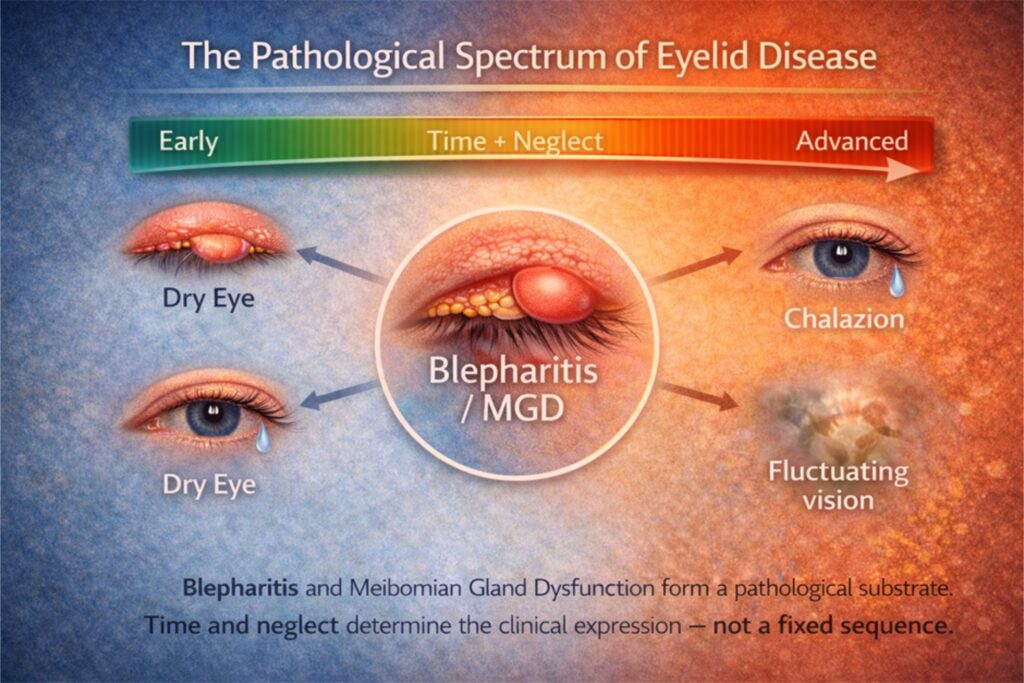
3. Blepharitis – MGD – Chalazion: A Unified Spectrum
- Chronic eyelid inflammation
- Progressive obstruction of Meibomian glands
- Tear film instability
- Retention of secretions
- Granulomatous reaction (chalazion)
Chalazion is not the beginning.It is a late-stage manifestation.
- The Microenvironment as a Determinant of Disease
Disease is not defined solely by:
- cells
- tissues
- medications
But by the functional environment:
- lipid burden
- microbial balance
- mechanical function
- daily hygiene
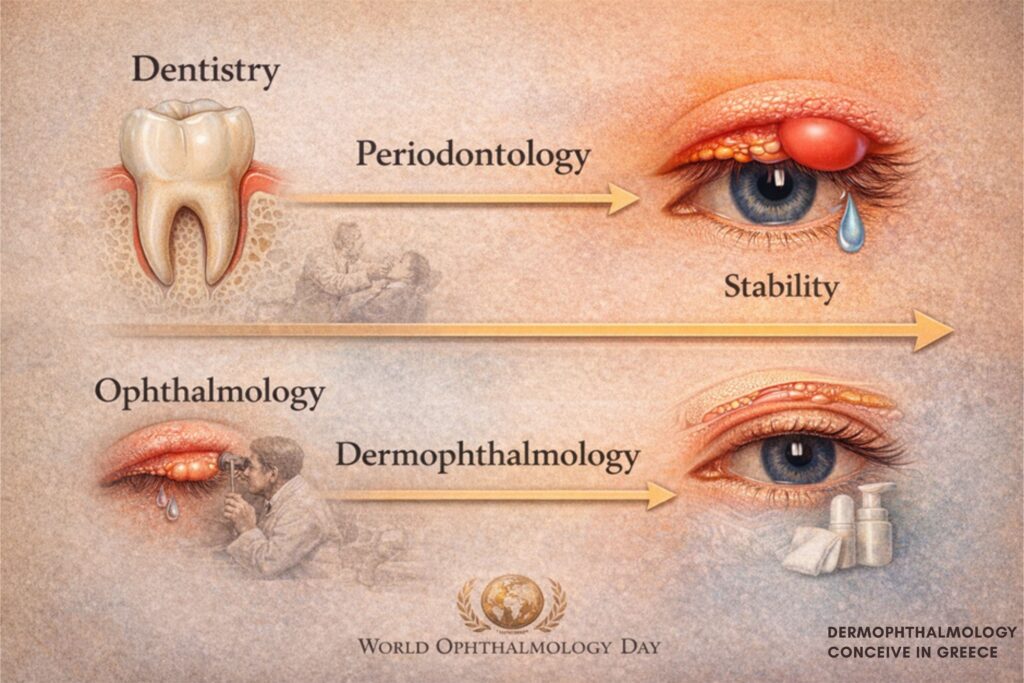
5. The Dental Analogy.
-
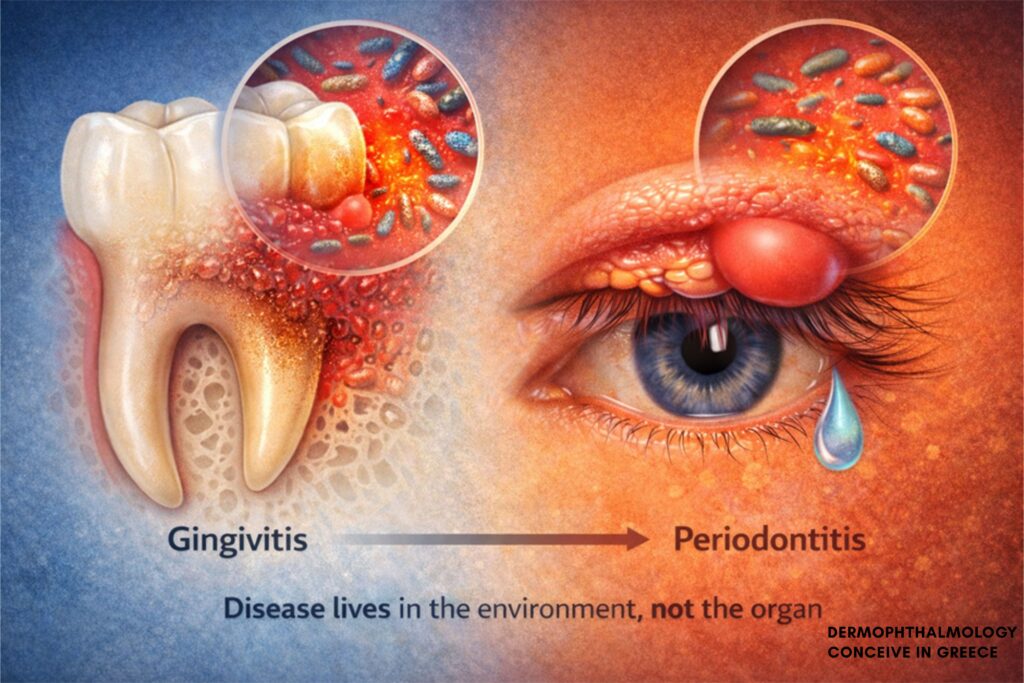
The eyelid is to the eye what the periodontium is to the tooth.
Periodontium
- supports
- protects
- regulates the environment
- when inflamed → the tooth is lost
Eyelid
- protects the ocular surface
- regulates the tear film
- houses functional glands
- when inflamed → ocular stability is lost
This is not a marketing analogy.It is biological accuracy.
- Historical Perspective – Ancient Greek Spectral Thinking.
Hippocrates did not describe disease as a moment, but as imbalance within the whole.The concept of crisis presupposed a process.Modern medicine is now returning—matured and evidence-based—to this way of thinking.
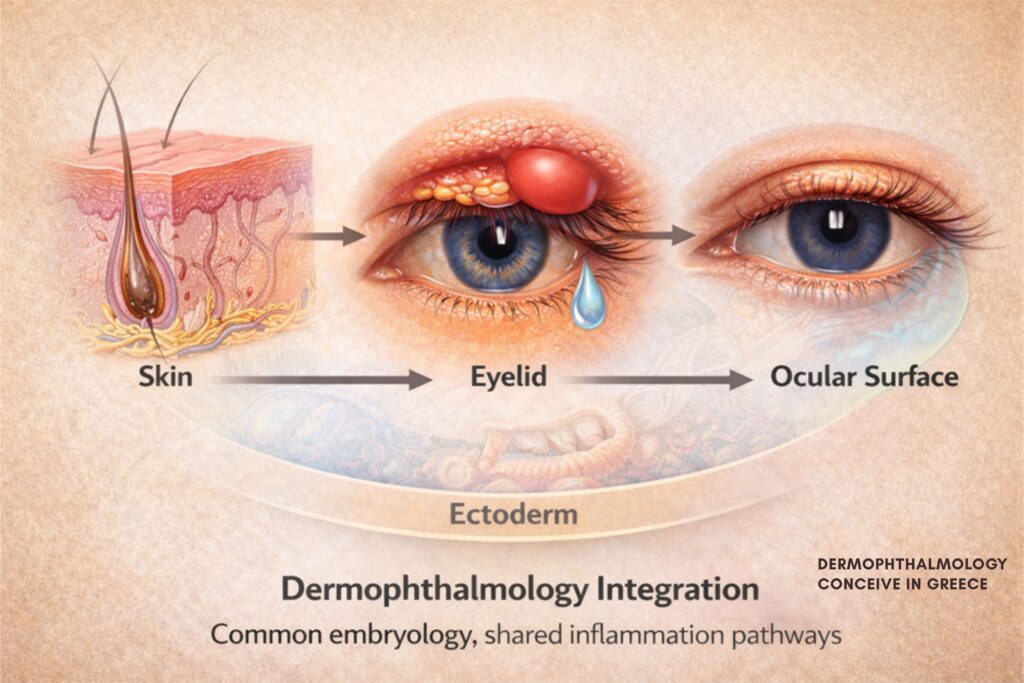
7. Dermophthalmology as an Integrative Framework.
Skin and ocular surface share:
- common embryological origin (ectoderm)
- a shared microenvironment
- overlapping inflammatory pathways
Dermophthalmology does not replace Ophthalmology.It completes and deepens it.
- Clinical and Public Health Implications.
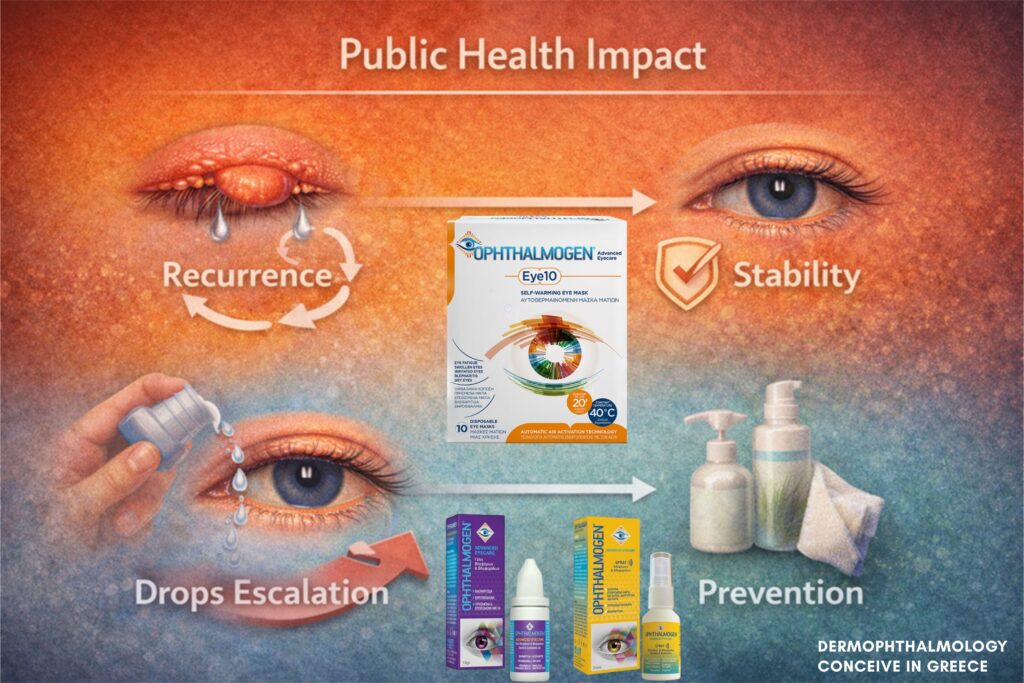
- Reduced recurrence rates
- Improved patient adherence
- Decreased unnecessary pharmacological use
- Shift toward prevention
- Population education
Hygiene evolves from “advice” to a therapeutic tool.
- Conclusion.
Ophthalmology is transitioning:
- from isolation
- to spectrum
- from symptom
- to substrate
- from reaction
- to prevention
Dermophthalmology represents the scientific vehicle of this transition.
Acknowledgements
This Concept Chapter was developed within the framework of the interdisciplinary approach of Dermophthalmology, aiming to bridge Ophthalmology, Dermatology, Public Health, and contemporary preventive medicine.
Scientific Alignment & Institutional Context
This work aligns with:
- TFOS DEWS II
- International Workshop on Meibomian Gland Dysfunction
- contemporary studies on low-grade chronic inflammation
and is positioned within the scientific vision of theWOD – World Organization of Dermophthalmology.
References (Curated – indicative)
- TFOS DEWS II – Pathophysiology & Management Reports
- Nichols KK et al., Meibomian Gland Dysfunction
- Lindsley K et al., Blepharitis – Cochrane Review
- Liu J et al., Association between blepharitis and chalazion
- Elias PM, Skin Barrier Function
- Chapple ILC et al., Periodontal Health and Disease
- Hippocratic Corpus – On Prognostics
- Proksch E et al., The Skin Barrier
- International Workshop on MGD (2011)