
- Introduction: A New Bridge Between Dermatology & Ophthalmology
The publication of the Blepharo–Skin Axis in the December 2025 issue of INFODERMA marks the first official recognition of a concept that redefines the physiology, pathology and clinical approach of the eyelid.
Official INFODERMA Publication (Dermatology Community):https://infoderma.gr/derma_153/infoderma_153_all.pdf
For the first time, dermatologists and ophthalmologists share a unified framework to understand:
- why dermatologic diseases frequently involve the eyelids
- why eyelid dysfunction destabilizes the ocular surface
- why prevention and daily care are essential
- why a new interdisciplinary field — Dermophthalmology — is emerging
- What Is the Blepharo–Skin Axis?
The Blepharo–Skin Axis describes the functional continuum between:
- Skin physiology
- Eyelid structure
- Meibomian gland function
- Tear film stability
- Ocular surface immunity
It recognizes that the eyelid is not simply “skin near the eye,”but a dermato-ophthalmic organ whose:
- keratinization,
- lipid composition,
- microbiome balance,
- glandular activity
- inflammatory state
directly influence visual comfort and ocular health.This axis explains why dermatologic inflammation so often becomes ocular pathology.
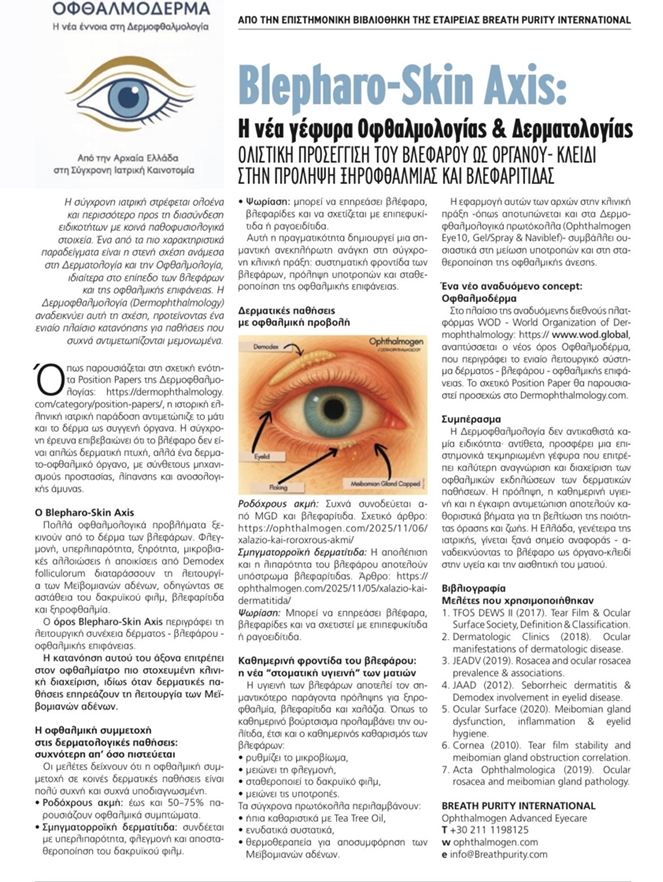
- Dermatologic Diseases With Ocular Involvement
Rosacea
Up to 50–75% of patients develop:
- Meibomian Gland Dysfunction (MGD)
- chronic blepharitis
- burning sensation
- ocular surface instability
A complete explanation:https://ophthalmogen.com/2025/11/06/xalazio-kai-roroxrous-akmi/
Seborrheic Dermatitis
Leads to:
- flaking along the lid margin
- increased microbial load
- chronic inflammation
- tear film instability
More analysis:https://ophthalmogen.com/2025/11/05/xalazio-kai-dermatitida/
Psoriasis
Can affect:
- eyelid skin
- lash line anatomy
- conjunctival and uveal immunity
These patterns highlight the need for shared protocols between dermatology & ophthalmology.
- Daily Eyelid Care: The “Oral Hygiene” of Modern Eye Health
The analogy is scientifically accurate:Just as oral hygiene prevents gingivitis,daily eyelid hygiene prevents blepharitis, MGD and ocular surface inflammation.
Evidence-based eyelid care stabilizes:
- microbiome balance
- Meibomian secretion quality
- eyelid keratinization
- tear film lipid layer
- ocular surface homeostasis
Current clinical protocols incorporate:
- Gentle cleansing with Tea Tree Oil
- Moisturizing & anti-inflammatory ingredients
- Warm compress therapy at ~40°C
- Biofilm reduction
- Demodex control
DermOphthalmic routines OphthalmogenEye10/ Gel/ Spray reflect these principles.
- Introducing a New Concept: Ophthalmoderma
Through the emerging platform World Organization of Dermophthalmology (WOD):https://www.wod.globalthe term Ophthalmoderma (Οφθαλμόδερμα) is being developed to describe:
- the functional unity of skin–eyelid–ocular surface
- the anatomical & embryological continuum (ectoderm origin)
- the shared inflammatory pathways
- the dermatologic determinants of ocular comfort
- the aesthetic and biomechanical role of eyelid skin
A full scientific Position Paper is in preparation and will be published on:https://dermophthalmology.com/category/position-papers/
- Why the INFODERMA Publication Is a Milestone
Because for the FIRST TIME:
- a dermatology journal presents eyelid physiology as a shared field
- Dermophthalmology enters formal medical dialogue
- clinicians receive a unified conceptual framework
- Greece becomes the birthplace of this new medical paradigm
- both specialties begin harmonizing their language and approach
This is foundational work for the future:
- training programs
- clinical protocols
- international guidelines
- interdisciplinary societies
- ophthalmo-dermal therapeutics
preventive eyelid care
- Conclusion
The Blepharo–Skin Axis is more than a concept.It is the scientific backbone of Dermophthalmology.
It provides clinicians with:
- clarity
- structure
- shared vocabulary
- pathophysiologic insight
- preventive strategies
- therapeutic pathways
Dermophthalmology is being built step by step,from Greece to the world.And this publication marks the beginning of a new era.
References
- TFOS DEWS II Report (2017)
- Dermatologic Clinics, Ocular Manifestations (2018)
- JEADV – Rosacea & Ocular Disease (2019)
- JAAD – Seborrheic Dermatitis & Eyelid Pathology (2012)
- Ocular Surface – MGD & Eyelid Inflammation (2020)
- Cornea – Tear Film Stability & Meibomian Function (2010)
- Acta Ophthalmologica – Ocular Rosacea (2019)