
Why eye health does not begin when disease appears
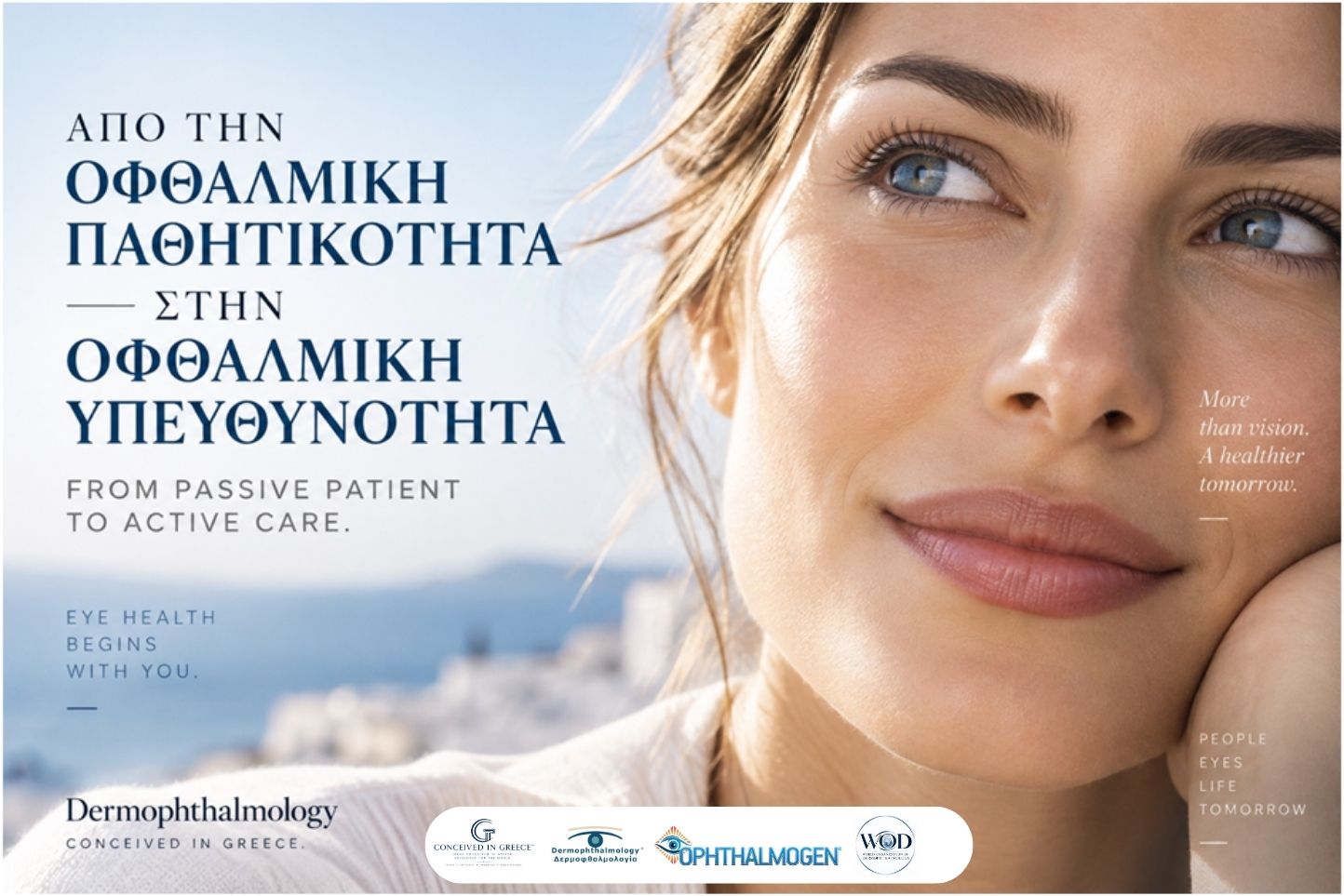
FROM THE PASSIVE PATIENT TO ACTIVE CARE
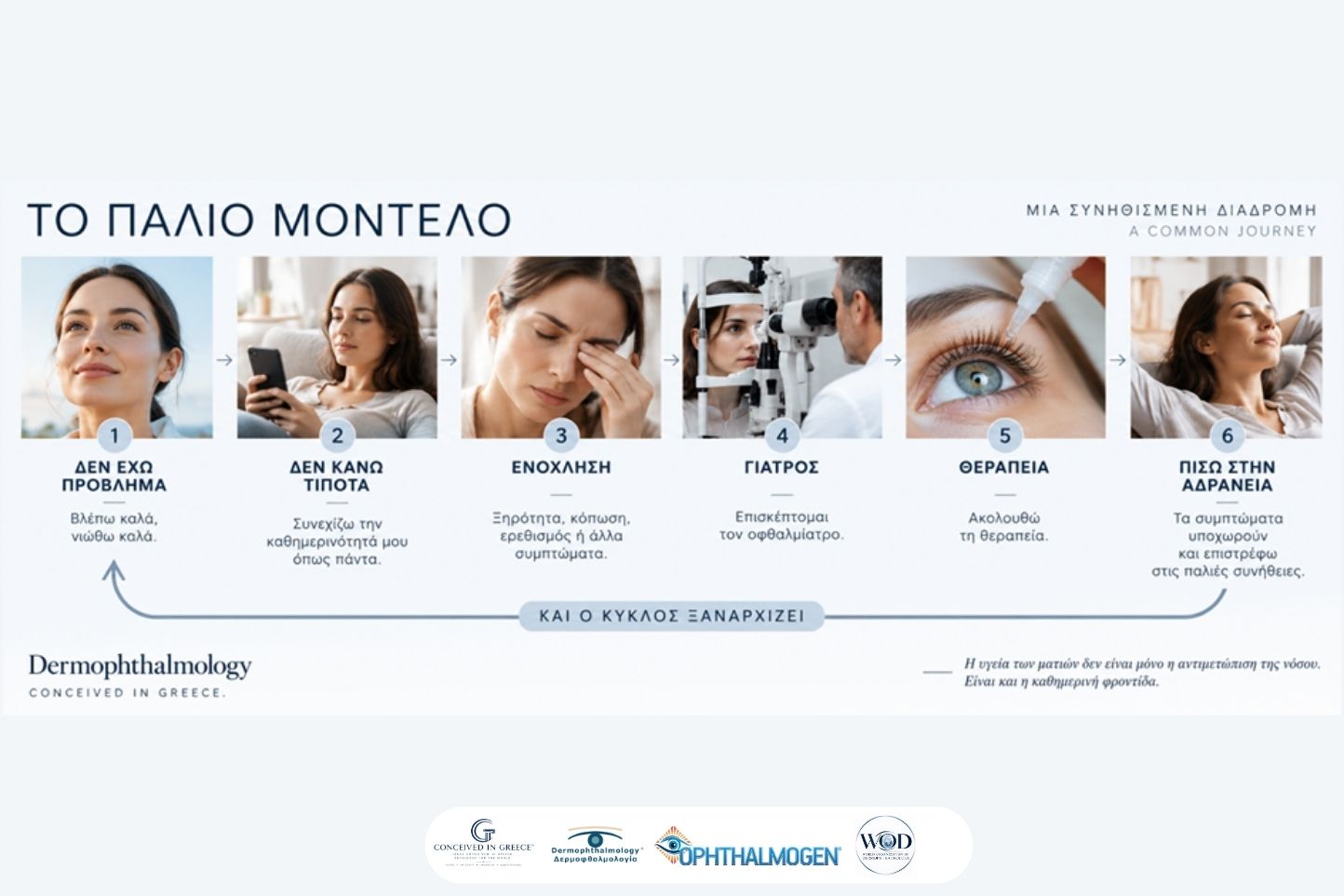
For decades, many people’s relationship with their eye health has followed a relatively simple model:
I have no problem → I do nothing.
I feel discomfort → I wait.
The problem persists → I visit the ophthalmologist.
There is a diagnosis → I follow the treatment.
And then, very often:
I no longer have a problem → I go back to inaction.
This model has a logical basis.
The ophthalmologist is the specialist who has the scientific knowledge and clinical competence to examine the eye, diagnose a condition, monitor its course and, when required, recommend the appropriate treatment.
There is, however, a different question:
Who takes care of our eyes on all the other days of our lives?
Who is responsible for our daily habits?
For the hygiene of the eyelids and eyelashes?
For the correct use of contact lenses?
For the way we use products around the eyes?
For the many hours spent in front of screens?
For the environment in which the ocular surface functions every day?
And above all:
Do we really have to wait for a problem to appear before we start paying attention to the daily care of our eyes?
The paradox of everyday health
Modern society has developed an entire culture of daily body care.
We brush our teeth.
We wash our face.
We take care of our skin.
We wash our hands.
We use sun protection.
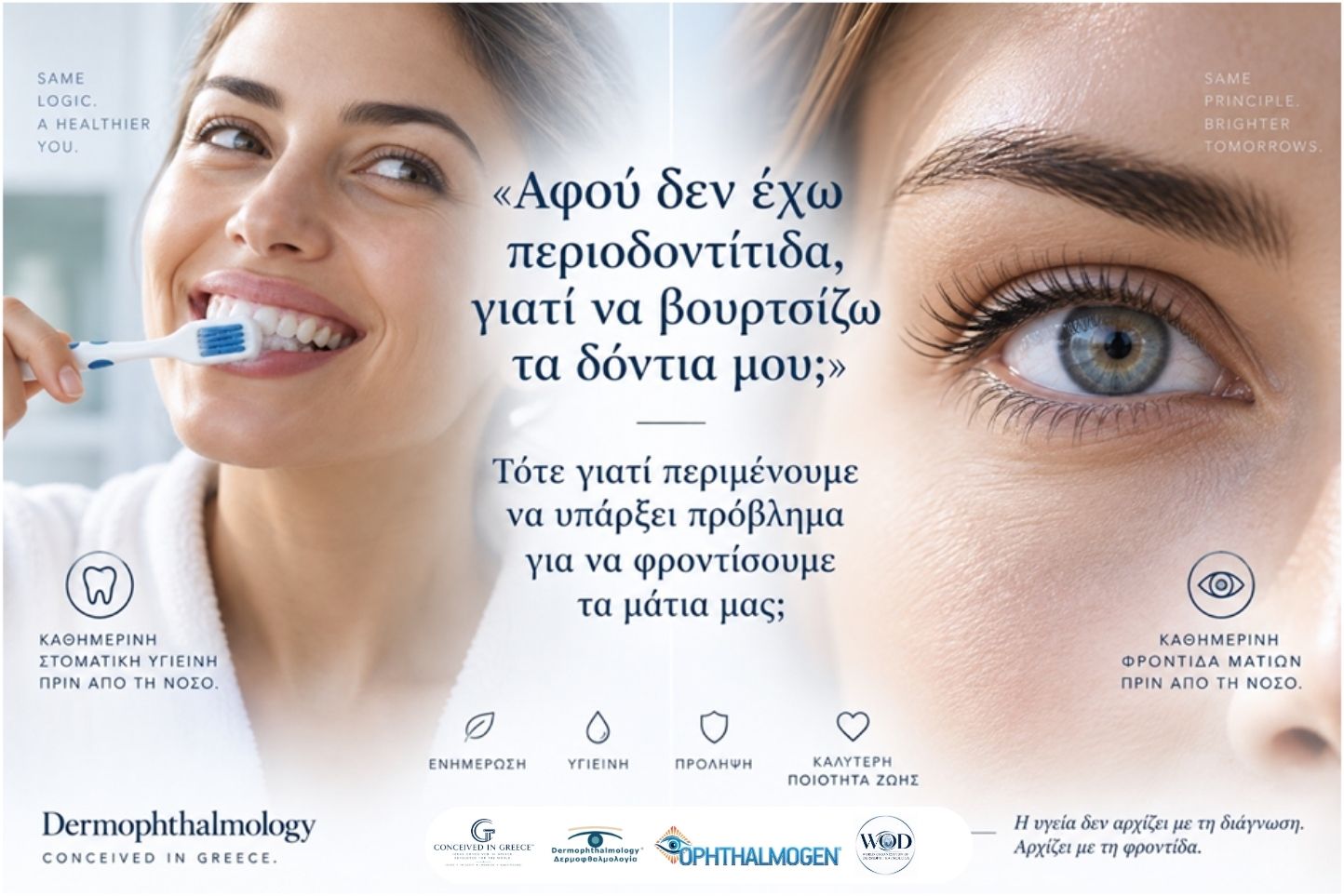
We do not wait for periodontal disease to appear before we start brushing our teeth.
We do not wait for a skin disease to appear before we start cleansing our face.
Hygiene is part of everyday health before disease.
And yet, when it comes to the eyes, the everyday culture of care is far less established.
There is the ophthalmologist.
There are preventive examinations.
There are glasses and contact lenses.
There are eye drops.
There are pharmaceutical and surgical treatments when they are indicated.
But between:
“I have no diagnosed problem”
and:
“I need medical treatment”
there is a vast everyday space.
The space of information, hygiene and daily care.
The eye does not live only inside the doctor's office
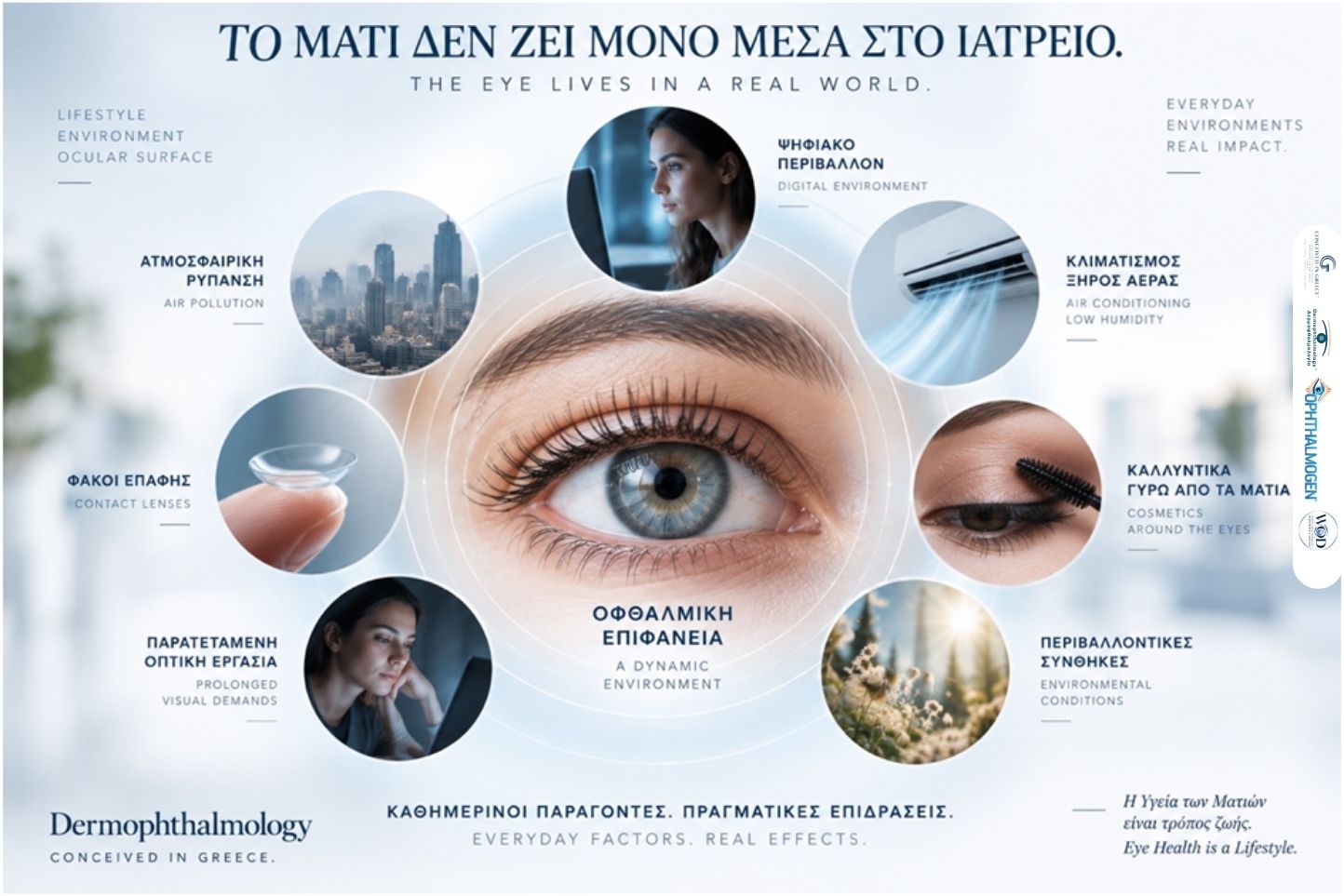
Our eyes function every day within a real and constantly changing environment.
In front of screens.
In air-conditioned spaces.
In low-humidity conditions.
Amid air pollution.
With contact lenses.
With eyeliner, mascara, eyelash extensions and other cosmetic products around the periocular area.
With many hours of concentration and visual work.
The international scientific literature recognises that lifestyle and environment can interact with the health of the ocular surface.
The TFOS Lifestyle Workshop systematically examined factors such as the digital environment, contact lenses, cosmetics and environmental conditions in relation to the ocular surface.[1–5]
Prolonged use of digital devices has been associated with changes in blinking behaviour and with signs or symptoms related to the ocular surface.[2,6]
Environmental conditions — such as low humidity, temperature and certain atmospheric factors — can also affect the ocular surface.[5]
Similarly, contact lens wear requires proper hygiene and care behaviours,[3] while cosmetics and certain aesthetic practices around the eyes can, under specific conditions, interact with the ocular surface.[4]
Everyday life is therefore not merely the interval between two visits to the ophthalmologist.
It is the environment in which our eyes function continuously.
An interdependent ocular environment
The anterior ocular surface does not function in isolation.
The tear film, the eyelids, the meibomian glands and the ocular surface take part in a dynamic and interdependent system.
The modern scientific approach to dry eye disease recognises the important role of tear film homeostasis and meibomian gland function.[7–9]
McDonald and her colleagues have also highlighted the functional importance of the tear film and the ocular surface, as well as the relationship between dry eye disease and daily functioning and quality of life.[9,10]
The tear film is not simply “moisture” on the eye. It contributes to maintaining the health of the ocular surface and to creating a smooth optical surface, which is important for the quality of vision.[9]
Dermophthalmology proposes that we look at this environment even more broadly, including the functional relationship between the ocular surface, the eyelids, the eyelashes and the periocular skin.
This broader functional framework is described through concepts such as:
Ophthalmoderma
Ophthalmodermal Barrier
These concepts constitute a proposed theoretical framework of Dermophthalmology and are not presented as established international diagnostic categories.
Their aim is to facilitate a more comprehensive discussion about the environment in which the ocular surface functions every day.
So who is responsible?
The answer cannot be:
“The doctor or the individual.”
These are not competing responsibilities.
They are different and complementary roles.
The ophthalmologist has the scientific training and the clinical competence for examination, diagnosis, monitoring and medical management.
The individual, however, has a different role.
To take an active part in the daily care of their own health.
To know the basic principles of hygiene.
To use contact lenses correctly.
To follow the treatment instructions when treatment has been prescribed.
To notice significant changes.
To recognise that persistent, severe or sudden symptoms need professional evaluation.
And, at the same time, to maintain daily habits that support the ocular environment.
The active individual does not replace the doctor.
They work better together with the doctor.
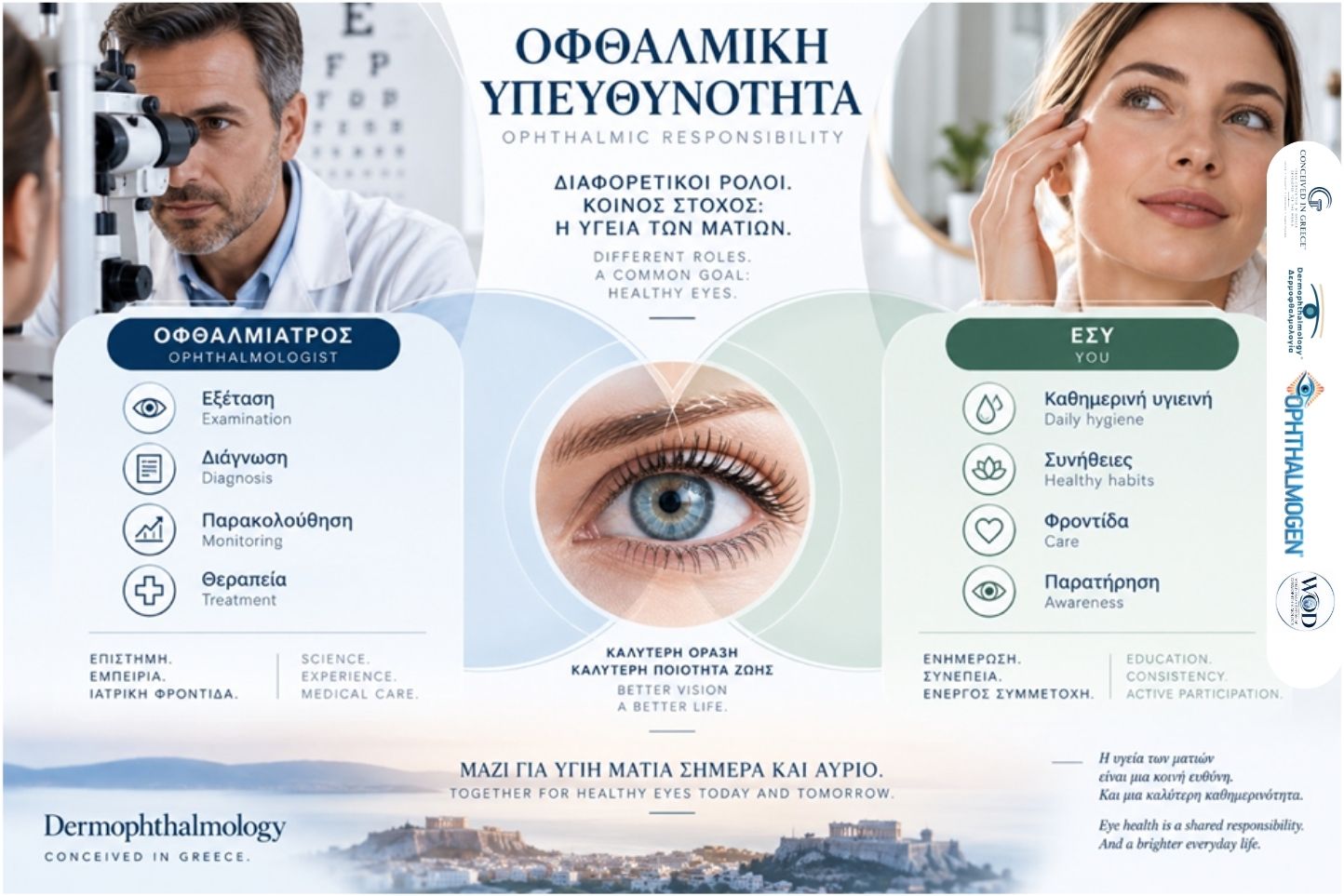
From Ophthalmic Passivity to Ophthalmic Responsibility
We can therefore describe two different cultures.
Ophthalmic Passivity
“I have no diagnosis, so I don’t need to bother.”
“As long as I see well, my eyes are fine.”
“When there is a problem, I will go to the ophthalmologist.”
“Someone else is responsible for the health of my eyes.”
However, the absence of marked symptoms does not always mean the absence of changes in the ocular surface.
Studies in specific populations of patients presenting for eye surgery have shown that objective signs of ocular surface disturbance may be more common than the symptoms alone would suggest.[12]
In contrast to the passive mindset, a different one can therefore be developed:
OPHTHALMIC RESPONSIBILITY
It does not mean self-diagnosis.
It does not mean self-treatment.
It does not mean distrust of the doctor.
It does not mean that every person needs the same daily routine.
And it certainly does not mean that daily care can replace the medical treatment of a condition.
It means something much simpler:
I recognise that I, too, have an active role in the everyday health of my eyes.
The example of teeth
Perhaps the easiest way to understand this transition is to think of something we now consider entirely self-evident.
Teeth.
No one would say:
“The dentist knows far more than I do about teeth, so the dentist is responsible for them and I don’t need to do anything.”
Nor:
“Since I don’t have periodontitis, why should I brush my teeth? I’ll start when they become diseased.”
The statement sounds absurd.
Why?
Because we have already learned to distinguish between two different concepts:
daily hygiene
and
professional care and treatment.
Brushing your teeth does not replace the dentist.
The dentist does not eliminate the need for daily oral hygiene.
The two coexist.
So why not develop a similar culture for the eyes as well?
A culture in which daily care does not compete with ophthalmology.
It complements it.
Health does not begin with diagnosis
For many years we have been used to thinking about health through an almost binary model:
Healthy ↔ Patient
Human biology, however, is more complex.
Risk factors, behaviours and functional changes can exist before a disease becomes established or is diagnosed.
Not in order to turn a healthy person into a patient.
But in order to underline something different:
Health has value before disease appears.
Between:
“I have no diagnosed condition”
and:
“I need treatment”
there is everyday life.
And within it there is room for information, appropriate hygiene, correct behaviours, observation and care.
Ophthalmic Responsibility is not fear
This is crucial.
Active participation in health must not turn into a constant search for disease.
The goal is not for someone to look at their eyes every day searching for a problem.
Nor to treat every normal variation as pathology.
Ophthalmic Responsibility is not based on fear.
It is based on knowledge.
In the same way that daily oral hygiene does not mean we fear periodontal disease every day.
We take care of something because it is part of our health.
This is a different philosophy:
HYGIENE BELONGS TO HEALTH, NOT ONLY TO DISEASE.
From the passive patient to the active individual
Even the word “patient” is of interest here.
A person is not a patient at every moment of their life.
They are a person who lives.
Who works.
Who uses screens.
Who may wear contact lenses.
Who uses skincare products or make-up.
Who travels.
Who is exposed to different environmental conditions.
Who uses their eyes from the moment they wake up until the moment they fall asleep.
That is why the real transition is perhaps not:
FROM THE PASSIVE PATIENT TO THE ACTIVE PATIENT.
It is:
FROM THE PASSIVE PATIENT TO ACTIVE CARE.
Care does not need to begin when someone receives a diagnosis.
It can be part of everyday life.
What does Ophthalmic Responsibility mean in practice?
It does not need to be complicated.
It means:
- knowing that the eyelids and eyelashes are part of the environment of the ocular surface,
- understanding that appropriate hygiene of the area can have a place in daily care,
- using contact lenses correctly and with good hygiene,
- removing eye make-up carefully,
- knowing that long hours of visual demand and environmental conditions can affect ocular comfort,
- following medical instructions when there is a treatment,
- not attempting to manage persistent or worrying symptoms on our own,
- knowing when an examination by an ophthalmologist is required,
- and not assuming that the absence of a diagnosed disease means that every form of daily care is unnecessary.
Could what we considered normal have been a form of “Ophthalmic Irresponsibility”?
The question is deliberately provocative.
But not in order to blame the individual.
How could anyone practise a daily behaviour they were never taught?
For decades the public conversation about the eyes focused, understandably, on vision, on diseases, on refractive errors, on diagnosis and on treatment.
Daily care of the ocular environment did not gain a corresponding place in the culture of personal health.
Therefore, Ophthalmic Passivity should not be treated as a personal failure.
We can see it as a gap in education and health culture.
And cultural gaps can change through information.
The role of the ophthalmologist does not become smaller
The transition towards Ophthalmic Responsibility is not a move against medicine.
Nor is it a transfer of diagnosis and treatment to the individual.
On the contrary, a better-informed person can better understand the importance of professional check-ups, follow medical instructions more accurately and recognise that certain symptoms must not be ignored.
The relationship can therefore shift from:
“The doctor is solely responsible for my eyes.”
to:
“The doctor and I have different but complementary roles in the health of my eyes.”
Diagnosis and medical treatment belong to clinical practice.
Daily behaviour, however, takes place mainly:
outside the doctor’s office.
From treatment when needed, to care every day
The next era of eye health does not need to choose between medicine and daily care.
It needs to know the place of each.
MEDICAL CARE WHEN NEEDED.
DAILY CARE, EVERY DAY.
This is the essence of Ophthalmic Responsibility.
To know when we need to seek professional help.
To follow evidence-based treatment when it is required.
And, at the same time, not to hand over the entire responsibility for our everyday health to a future visit to the doctor.
From philosophy to everyday practice
Within this framework, appropriate daily care of the ocular environment can gain a greater place in the culture of personal health.
Daily care systems such as Ophthalmogen Advanced Eyecare have been developed within this rationale: not as substitutes for medical diagnosis or treatment, but as tools for the daily care of the eyelid area and the ocular environment.
The most important change, however, is not a product.
It is a behaviour.
The transition from:
“I will deal with my eyes when there is a problem.”
to:
“I take care of my eyes because they are part of my everyday health.”
OPHTHALMIC RESPONSIBILITY
Health is not merely the management of disease.
It is also the everyday relationship we have with our body before disease appears.
We learned this for our teeth.
We learned this for our skin.
For hand hygiene we take it for granted.
Perhaps the time has come to develop a similar culture for the eyes as well.
To move from passivity to participation.
From reaction to care.
From thinking exclusively about disease to a broader everyday culture of health.
FROM THE PASSIVE PATIENT TO ACTIVE CARE.
MEDICAL CARE WHEN NEEDED.
DAILY CARE, EVERY DAY.
HYGIENE BELONGS TO HEALTH.
Dermophthalmology
Eye Hygiene is Culture.
Conceived in Greece
Scientific References
- Craig JP, Alves M, Wolffsohn JS, Downie LE, Efron N, Galor A, et al. TFOS Lifestyle Report Executive Summary: A Lifestyle Epidemic – Ocular Surface Disease.The Ocular Surface. 2023;30:240–253. doi:10.1016/j.jtos.2023.08.009.
- Wolffsohn JS, Lingham G, Downie LE, Huntjens B, Inomata T, Jivraj S, et al. TFOS Lifestyle: Impact of the digital environment on the ocular surface. The Ocular Surface. 2023;28:213–252. doi:10.1016/j.jtos.2023.04.004.
- Jones L, Efron N, Bandamwar K, Barnett M, Jacobs DS, Jalbert I, et al. TFOS Lifestyle: Impact of contact lenses on the ocular surface. The Ocular Surface.2023;29:175–219. doi:10.1016/j.jtos.2023.04.010.
- Sullivan DA, da Costa AX, Del Duca E, Doll T, Grupcheva CN, Lazreg S, et al. TFOS Lifestyle: Impact of cosmetics on the ocular surface. The Ocular Surface.2023;29:77–130. doi:10.1016/j.jtos.2023.04.005.
- Alves M, Asbell P, Dogru M, Giannaccare G, Grau A, Gregory D, et al. TFOS Lifestyle Report: Impact of environmental conditions on the ocular surface. The Ocular Surface. 2023;29:1–52. doi:10.1016/j.jtos.2023.04.007.
- Talens-Estarelles C, García-Marqués JV, Cerviño A, García-Lázaro S. Use of digital displays and ocular surface alterations: A review. The Ocular Surface.2021;19:252–265. doi:10.1016/j.jtos.2020.10.001.
- Perez VL, Chen W, Craig JP, Dogru M, Jones L, Stapleton F, Wolffsohn JS, Sullivan DA. TFOS DEWS III: Executive Summary. American Journal of Ophthalmology.2026;282:135–145. doi:10.1016/j.ajo.2025.09.035.
- TFOS DEWS III: Management and Therapy. American Journal of Ophthalmology. 2025;279:289–386. doi:10.1016/j.ajo.2025.05.039.
- Matossian C, McDonald M, Donaldson KE, Nichols KK, MacIver S, Gupta PK. Dry Eye Disease: Consideration for Women’s Health. Journal of Women’s Health.2019;28(4):502–514. doi:10.1089/jwh.2018.7041.
- McDonald M, Patel DA, Keith MS, Snedecor SJ. Economic and Humanistic Burden of Dry Eye Disease in Europe, North America, and Asia: A Systematic Literature Review. The Ocular Surface. 2016;14(2):144–167. doi:10.1016/j.jtos.2015.11.002.
- McDonald M, D’Aversa G, Perry HD, Wittpenn JR, Donnenfeld ED, Nelinson DS. Hydroxypropyl Cellulose Ophthalmic Inserts (Lacrisert) Reduce the Signs and Symptoms of Dry Eye Syndrome and Improve Patient Quality of Life. Transactions of the American Ophthalmological Society. 2009;107:214–221.
- Trattler WB, Majmudar PA, Donnenfeld ED, McDonald MB, Stonecipher KG, Goldberg DF. The Prospective Health Assessment of Cataract Patients’ Ocular Surface (PHACO) Study: The Effect of Dry Eye. Clinical Ophthalmology. 2017;11:1423–1430.
Scientific & Editorial Note
The terms Ophthalmic Responsibility, Ophthalmoderma, Eye–Skin Axis, Ophthalmodermal Barrier and Pre-Disease, as used in this article, are concepts or proposed theoretical frameworks of Dermophthalmology Conceived in Greece.
They are not presented as established international diagnostic entities or official medical classifications.
The content is informational and educational and does not replace individualised medical evaluation, diagnosis or treatment.