
“It is not always the sun’s fault. It may be your tear film, dry eye, or your eyelids.”
“I can’t tolerate lights like I used to.”
“LEDs tire me.”
“Night driving has become difficult.”
“My eyes water when I go out in the sun.”
“In the supermarket, I want to leave after a few minutes.”
If you have ever said any of these things, you are not alone.
Light sensitivity, also known as photophobia, is one of the most common and misunderstood symptoms of modern life.
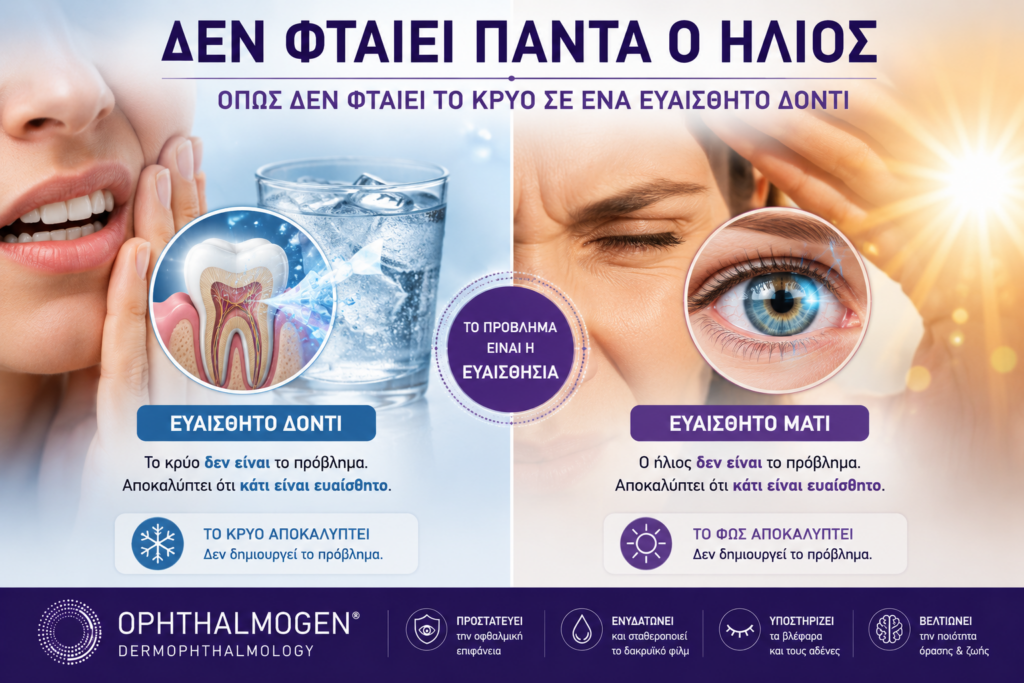
And perhaps the most important point is this:
Many people believe the problem is the light.
But very often, the real problem is that the visual system has become more vulnerable to light.
Exactly like when a tooth becomes sensitive to cold.
The cold water is not the real problem.
The cold water simply reveals that something has changed in the tooth.
The same may happen with the eyes.
Light does not always create the problem.
Very often, it reveals a problem that already exists.
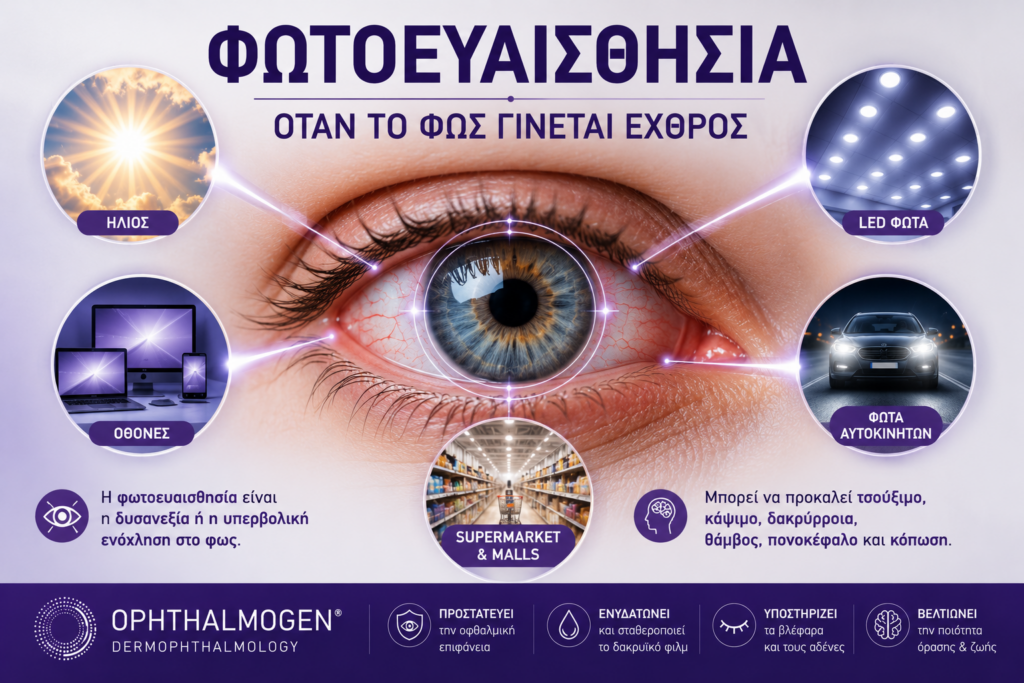
Photophobia is intolerance or excessive discomfort in response to light.
It may appear:
- in sunlight,
- under LED lighting,
- on screens,
- from car headlights,
- in shopping malls,
- in supermarkets,
- in offices,
- or even at home.
People describe:
- stinging,
- burning,
- tearing,
- headache,
- blurred vision,
- glare,
- halos,
- a feeling of pressure,
- or the need to close their eyes.
In more severe cases, photophobia can significantly affect:
- work,
- driving,
- reading,
- social life,
- and overall quality of life.
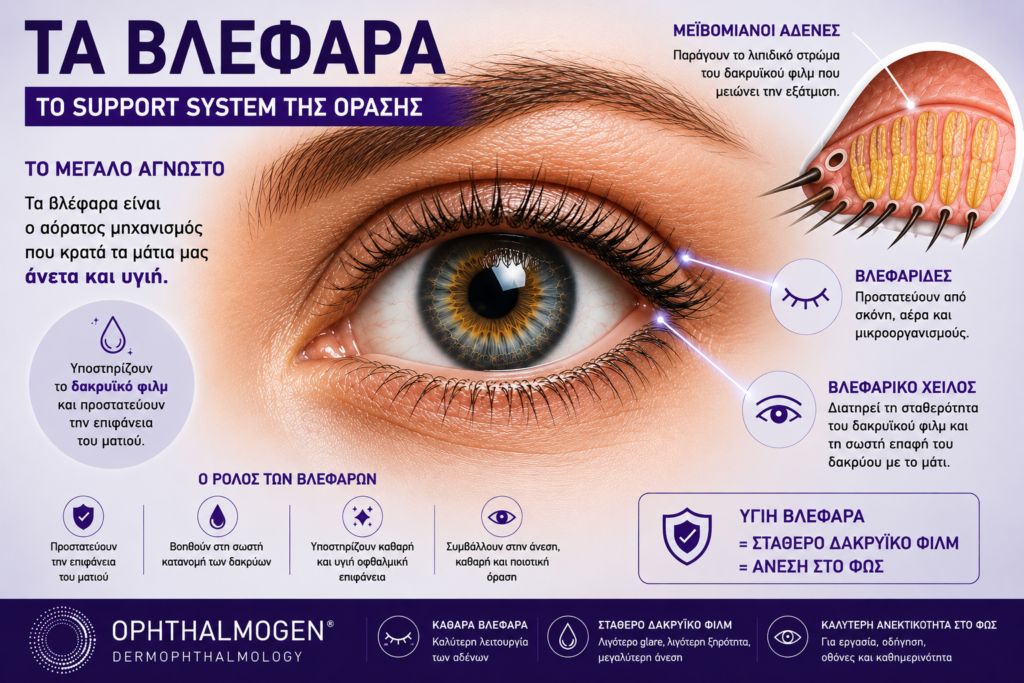
HOW COMMON IS IT?
Much more common than most people think.
International studies show that photophobia is often seen in people with:
- dry eye,
- blepharitis,
- MGD (meibomian gland dysfunction),
- migraine,
- neurological disorders,
- post-cataract surgery symptoms,
- LASIK,
- chronic stress,
- and prolonged screen exposure.
At the same time:
- more than 50–70% of people working on screens experience symptoms of digital eye strain,
- dry eye affects hundreds of millions of people worldwide,
- while light sensitivity is being reported more and more often in the modern LED era.
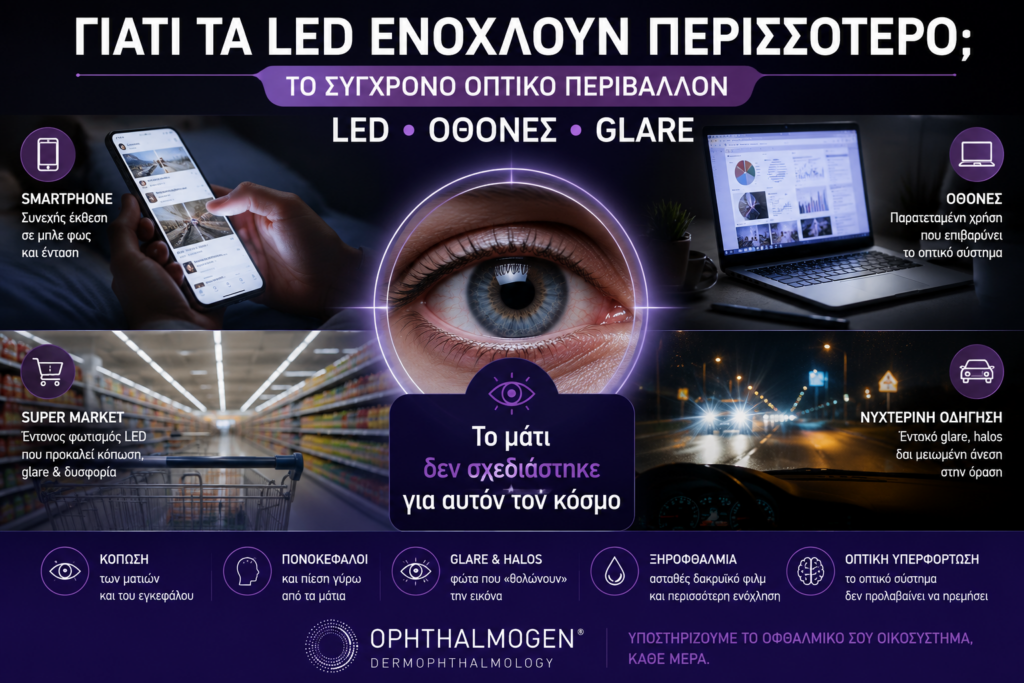
WHY IS IT WORSE TODAY?
The human eye did not evolve for:
- smartphones,
- tablets,
- LED screens,
- blue-rich lighting,
- modern night headlights,
- endless scrolling,
- visual overload.
For thousands of years, humans lived with:
- natural sunlight,
- fire,
- low evening light,
- and real darkness.
Today, the visual system is under constant sensory stimulation.
The result?
The eye and the brain never truly rest.
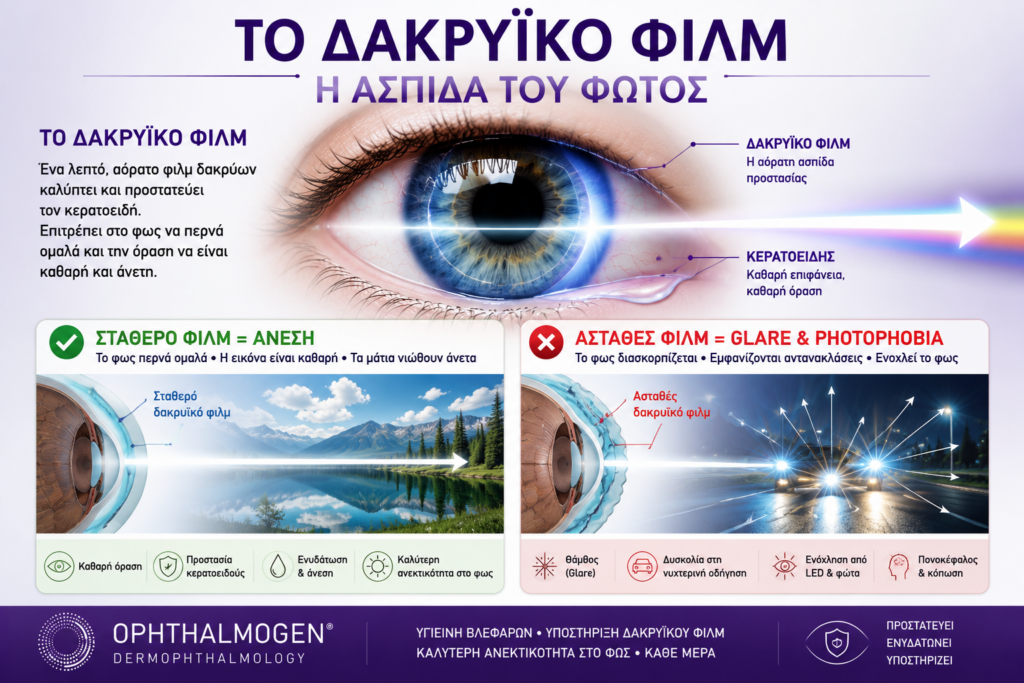
PHOTOPHOBIA IS NOT ONLY AN EYE ISSUE
Photophobia is not only about light.
It also involves:
- the tear film,
- the eyelids,
- blinking,
- the meibomian glands,
- the nervous system,
- and neurovisual processing.
The eye constantly tries to:
- filter light,
- reduce glare,
- organize reflections,
- stabilize the image.
But when the system becomes tired, light starts becoming the enemy.
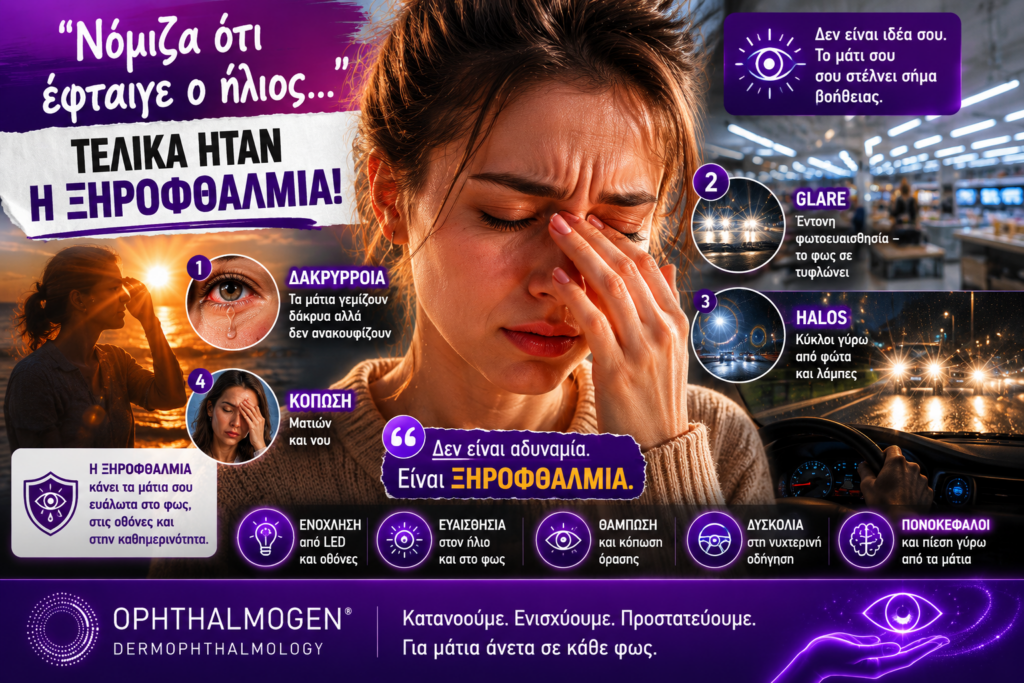
CAN DRY EYE MAKE LIGHT MORE UNCOMFORTABLE?
Yes.And perhaps much more than most people imagine.
When the tear film becomes unstable:
- glare increases,
- light scattering increases,
- halos appear,
- reflections increase,
- and light feels “harsher.”
Many people describe:
“Lights blind me.”
“LEDs hit my eyes.”
“I can’t tolerate street lights anymore.”
Very often, unstable tear film lies behind these symptoms.
PHOTOPHOBIA AND BLEPHARITIS
Blepharitis is one of the most common causes of chronic eyelid irritation.
It may cause:
- burning,
- dryness,
- foreign body sensation,
- tearing,
- and light sensitivity.
Why?
Because it affects the normal function of the eyelids and meibomian glands.And when the eyelids do not function properly, the tear film loses stability.
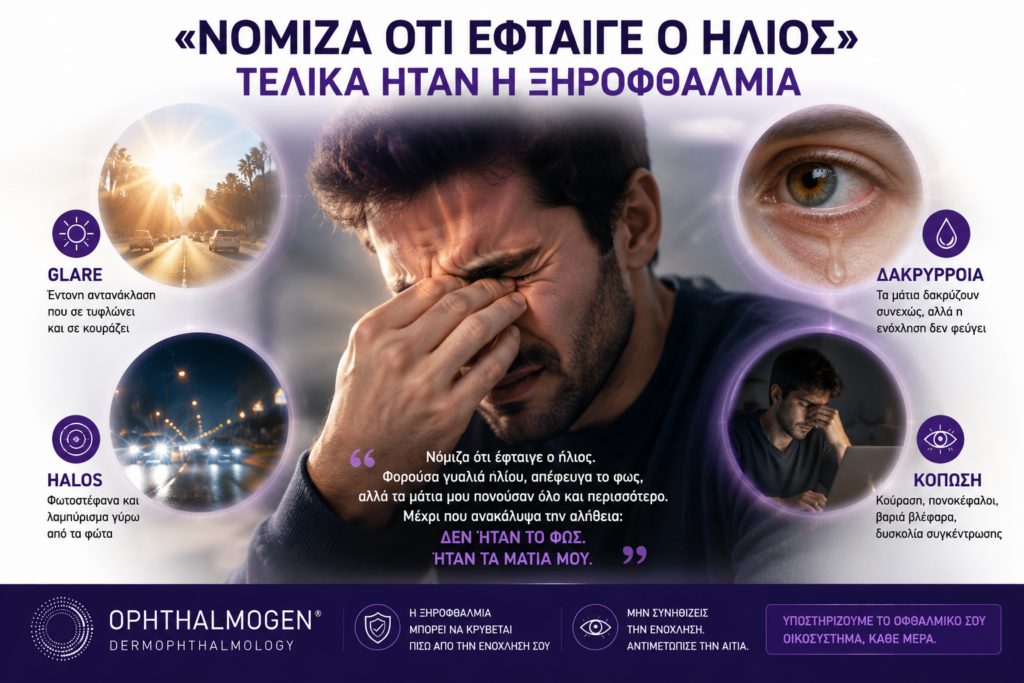
PHOTOPHOBIA AND MEIBOMIAN GLANDS (MGD)
The meibomian glands produce the lipid layer of the tears.
This lipid layer:
- reduces evaporation,
- stabilizes the tear film,
- and contributes to visual comfort.
When MGD appears:
- evaporation increases,
- the eye becomes dry,
- light scatters more,
- and photophobia becomes worse.
PHOTOPHOBIA AFTER CATARACT SURGERY
Many patients say:“I see more clearly, but lights bother me more.”
This often happens because:
- more light reaches the retina,
- dry eye may coexist,
- unstable tear film may be present,
- or chronic eyelid dysfunction may have existed before surgery.
Cataract surgery improves vision.
But it does not always correct the condition of the ocular surface.
PHOTOPHOBIA AFTER LASIK
Light sensitivity is a common symptom after LASIK.
It is often associated with:
- dry eye,
- neurosensory changes,
- unstable tear film,
- and increased glare.
For many people, proper ocular surface care is an important part of recovery.
PHOTOPHOBIA AND MIGRAINE
People with migraine often experience increased sensitivity to light.Even between attacks.
The relationship between:
- light,
- the brain,
- the nervous system,
- and visual processing
is far more complex than previously believed.
WHY DO LIGHTS BOTHER ME AT NIGHT?
Night driving is one of the most common complaints.
People report:
- intense glare,
- halos,
- blurred vision,
- difficulty concentrating,
- and fatigue.
Contributing factors often include:
- dry eye,
- MGD,
- blepharitis,
- unstable tear film,
- and the increased intensity of modern LED headlights.
12 SYMPTOMS THAT OFTEN ACCOMPANY PHOTOPHOBIA
- Dry eye
- Burning
- Stinging
- Tearing
- Red eyes
- Blurred vision
- Halos
- Glare
- Heavy eyelids
- Headaches
- Visual fatigue
- Difficulty with night driving
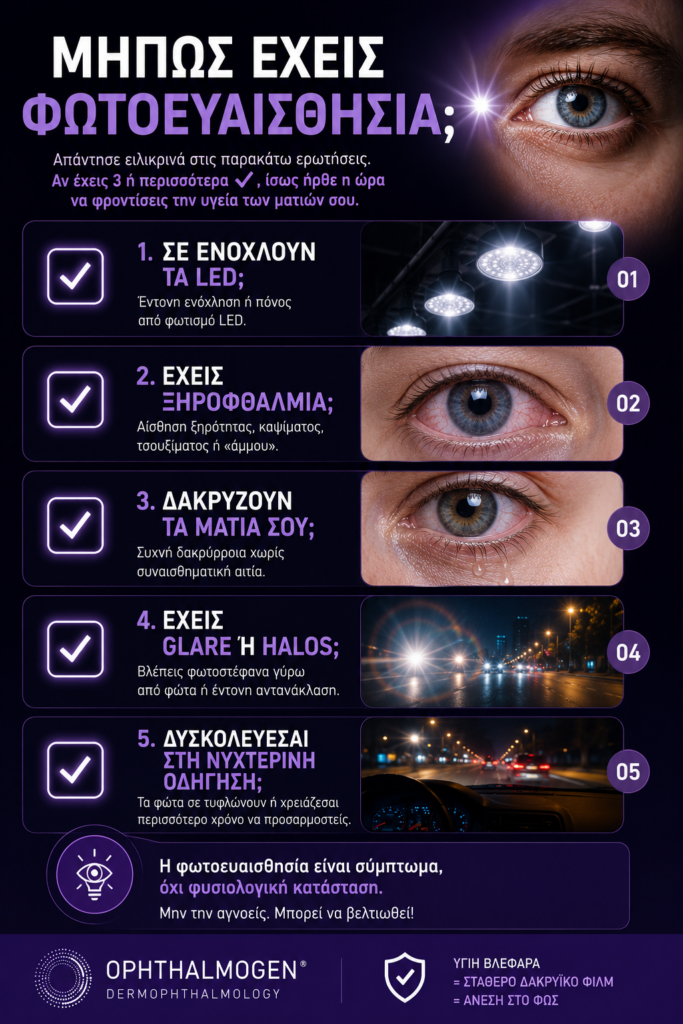
SELF-ASSESSMENT
Could your light sensitivity be related to your eyelids?
Answer YES or NO:
□ Do you have dry eye?
□ Do your eyes burn or sting?
□ Do LEDs bother you?
□ Do you have blepharitis?
□ Do you experience glare or halos?
□ Do you use screens for many hours?
□ Do your eyes water?
□ Do you feel better when you close your eyes?
If you answered YES to several questions, it may be worth evaluating the condition of your eyelids, meibomian glands, and ocular surface.
WHAT CAN YOU DO?
Management depends on the cause.
Common supportive measures include:
- regular breaks from screens,
- proper lighting,
- sunglasses when needed,
- dry eye evaluation,
- blepharitis management,
- support of meibomian gland function,
- and daily care of the ocular surface.
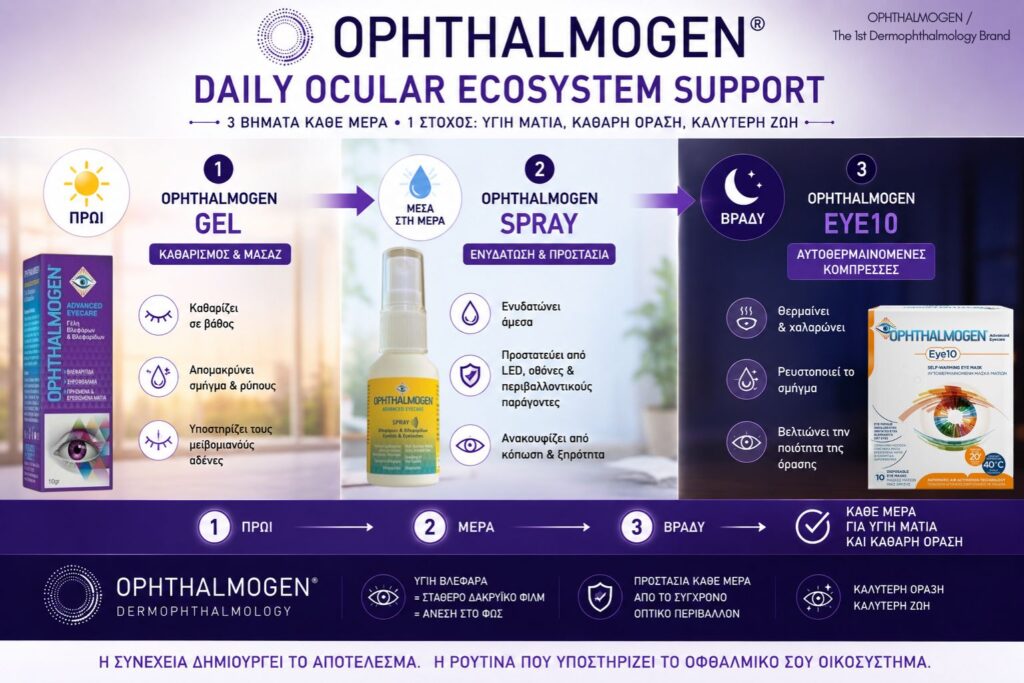
OPHTHALMOGEN DAILY OCULAR ECOSYSTEM SUPPORT
MORNING
OPHTHALMOGEN GEL
Eyelid cleansing & massage.
Goal:
- support of the meibomian glands,
- more stable tear film,
- calmer ocular surface.
DURING THE DAY
OPHTHALMOGEN SPRAY
Hydration & protection.
Use:
- at the office,
- after screens,
- in air-conditioned environments,
- in supermarkets,
- before night driving.
Many people report:
- greater comfort
- calmer eyes
- better tolerance to light
NIGHT
OPHTHALMOGEN EYE10
Self-heating eye compresses.
20 minutes.
Gentle thermotherapy helps support:
- meibomian gland function,
- the lipid layer of the tear film,
- and overall ocular surface comfort.
DERMOPHTHALMOLOGY AND THE NEW APPROACH
Modern Dermophthalmology studies the functional relationship between:
- the eyelids,
- meibomian glands,
- the tear film,
- the ocular surface,
- neurovisual balance,
- and quality of life.
It views the eye as:
- a functional ecosystem.
Because ultimately:vision is not only the image.
It is also the comfort with which you experience it.
SELECTED REFERENCES
- Craig JP et al. TFOS DEWS II Definition and Classification Report. Ocular Surface. 2017.
- Stapleton F et al. TFOS DEWS II Epidemiology Report. Ocular Surface. 2017.
- Bron AJ et al. TFOS DEWS II Pathophysiology Report. Ocular Surface. 2017.
- Nichols KK et al. The International Workshop on Meibomian Gland Dysfunction. Investigative Ophthalmology & Visual Science. 2011.
- Baudouin C et al. Revisiting the vicious circle of dry eye disease. British Journal of Ophthalmology. 2016.
- Digre KB, Brennan KC. Shedding Light on Photophobia. Journal of Neuro-Ophthalmology. 2012.
- Galor A et al. Neuropathic Ocular Pain and Neuro-Sensory Dysfunction. Progress in Retinal and Eye Research. 2018.
- Rosenfield M. Computer Vision Syndrome and Digital Eye Strain. Ophthalmic and Physiological Optics. 2016.
- Sheppard JD et al. Dry Eye Disease Associated with Modern Visual Environments. Clinical Ophthalmology. 2018.
- The Role of Meibomian Glands and Tear Film Stability in Visual Quality. Asia-Pacific Journal of Ophthalmology. 2020.
THE FINAL MESSAGE
Maybe the problem is not the light.
Maybe the problem is that your visual system has become more vulnerable to light.
Just as cold is not to blame when a sensitive tooth hurts,the sun is not always to blame when the eyes struggle to tolerate light.Because many times, what needs support is not the environment.It is the ocular ecosystem itself.
OPHTHALMOGEN®
Daily Eyelid Hygiene. Daily Ocular Ecosystem Support.
FAQ — Questions Thousands of People Ask About Photophobia
Why does light bother my eyes?
Photophobia may be associated with:
- dry eye,
- blepharitis,
- meibomian gland dysfunction (MGD),
- migraine,
- ocular surface inflammation,
- LASIK,
- cataract surgery,
- or prolonged exposure to screens and LED lighting.
Can dry eye cause photophobia?
Yes.
When the tear film becomes unstable:
- glare increases,
- reflections increase,
- halos appear,
- and light becomes more uncomfortable.
Why do LEDs bother me more than before?
Increased exposure to LED lighting, screens, and digital devices may overload the visual system.When dry eye or blepharitis coexist, many people report that LEDs feel “harsher” and more tiring.
Why can’t I tolerate night driving?
Night driving may become more difficult when there is:
- glare,
- halos,
- unstable tear film,
- dry eye,
- MGD,
- or photophobia.
Reflections from car headlights may then become more intense.
Can blepharitis cause photophobia?
Yes.Blepharitis affects the eyelids and meibomian glands, which contribute to tear film stability.When the tear film becomes unstable, light sensitivity may increase.
I have photophobia after cataract surgery. Is this normal?
Many patients report increased sensitivity to light after cataract surgery.Vision usually becomes clearer, but at the same time there may be:
- dry eye,
- glare,
- photophobia,
- or ocular surface instability.
I have photophobia after LASIK. Why?
After LASIK, many people experience:
- dry eye,
- glare,
- halos,
- and increased light sensitivity.
This is often related to changes in the ocular surface and tear film.
What do the eyelids have to do with photophobia?
The eyelids contain the meibomian glands, which produce the lipid layer of the tears.
When they dysfunction:
- tear evaporation increases,
- the eye becomes dry,
- and light becomes more uncomfortable.
Can daily eyelid hygiene help?
Modern Dermophthalmology considers that:
- the eyelids,
- blinking,
- the meibomian glands,
- and the tear film
play a critical role in visual comfort.
Daily eyelid care is an important part of supporting the ocular ecosystem.
Is photophobia dangerous?
Photophobia is not a diagnosis by itself.It is a symptom that may be associated with many different conditions.If it appears suddenly, is severe, or is accompanied by pain, reduced vision, or redness, an ophthalmologist should evaluate it.